
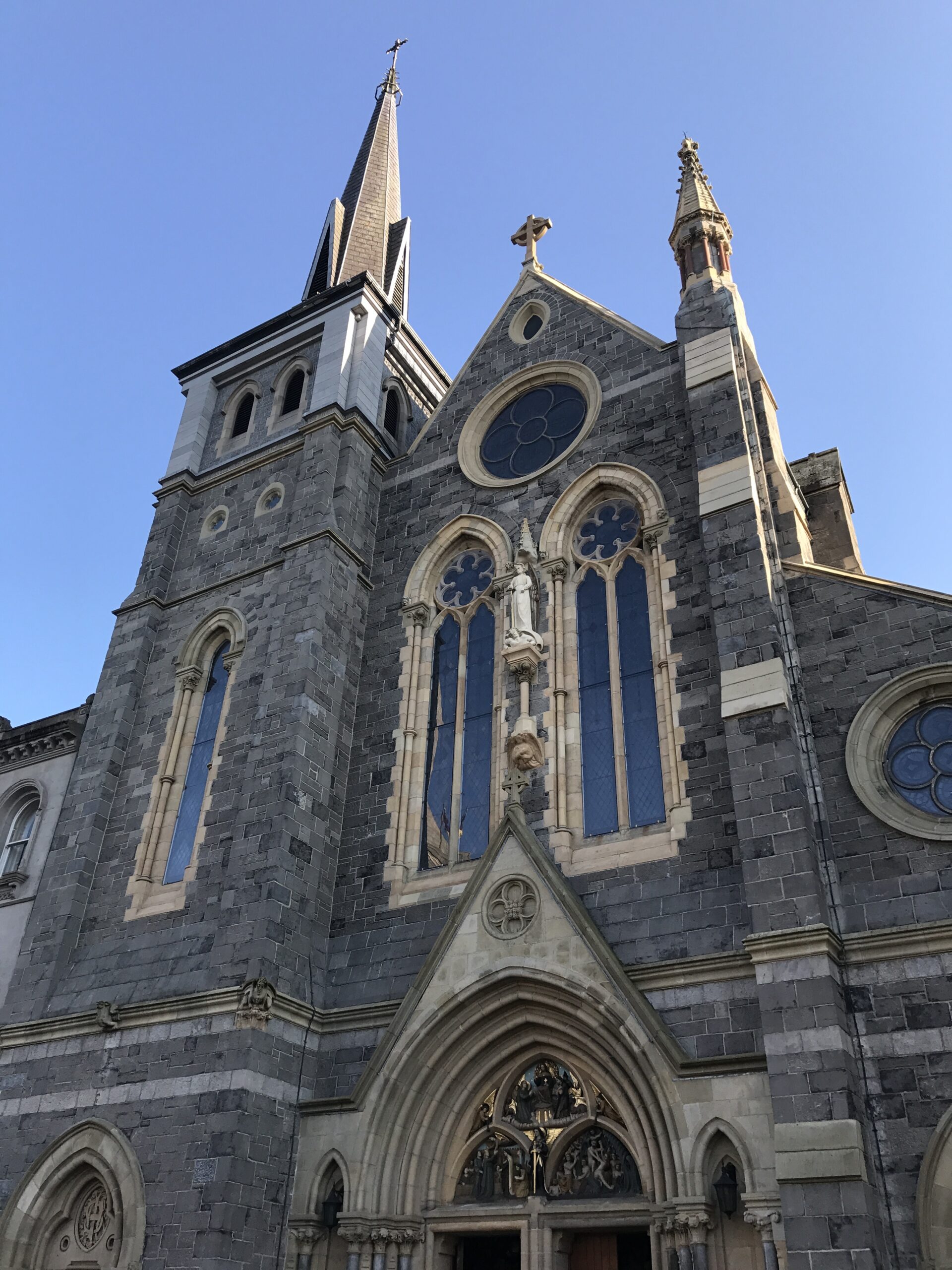
On the afternoon of Sunday 28 September 2025, the Vigil of the the Feast of St Michael the Archangel, a Mass of Thanksgiving was celebrated at St Michael’s Church, Enniskillen, to mark the 150th anniversary of the dedication of the church in 1875. The chief celebrant of the Mass on Sunday was the Bishop of Clogher, Most Reverend Larry Duffy. The homily was delivered by Monsignor Peter O’Reilly, PP, VG.
To mark the occasion, a special stone memorial was unveiled and blessed to acknowledge once more the contribution to the building of the St Michael’s by Archdeacon James McMeel, Parish Priest of Enniskillen from 1861 until 1882.
In his introductory remarks, Bishop Duffy said:
Today we gather to mark a great milestone in the history of this faith community. I welcome you all. I welcome the clergy and those from other Christian Churches.
St Michael’s Church is built on the site of an earlier church. That church was built in the early 1800s but by 1867 it was found to be not safe and not big enough for the size of the community.
On St Patrick’s Day 1875, this beautiful sacred space was opened. It cost £12,000 to build. In the process of building it, 2 workmen lost their lives. We remember them today too.
I was privileged to spend the first years of my priesthood here in this parish. My granduncle Fr Thomas Duffy was also a curate here for 6 years 1894 to 1900.
The building of this church was led by Archdeacon James McMeel, who we remember in this Mass. A Monaghan man, he was also the priest who had St Mary’s Church in Castleblayney built in the 1850s. That’s a parish I spent 16 years of ministry in.
The church is a building that is sacred because God is present here in a special way. God is also present in the people who come here to pray, present in the people who gather here to celebrate the Eucharist and the other sacraments. Conscious of this divine presence, we pause to call to mind our sins, our failings and our shortcomings. Let us ask the Lord to forgive us, to heal us and to make us one.
The following is the text of the homily by Monsignor Peter O’Reilly:
Dear Bishop, dear fellow clergy colleagues, dear Sisters, dear parishioner-friends in Christ, both here in the church and joining us online.
It is hardly surprising that our town, once a garrison for earthly soldiers, should have chosen St Michael as its Patron – the Archangel who leads heaven’s army. But Michael fights not for territory or conquest, but for something far more precious: our very humanity, our capacity for connection to each other and to God.
Today, at this autumn time of year, as we recall 150 years of spiritual harvest in this beautiful place, we remember that his battle continues.
Our celebration today carries within it a story both of loss and of restoration. When in 1995–96 this church underwent major renovation, the original commemorative brass plaque honouring Archdeacon James McMeel was taken down and somehow mislaid, never to be found. This loss is symbolic of how easily we can lose sight of our founding inspirations! How easily, without meaning to, we can misplace the very things that anchor our vision and purpose.
Archdeacon James McMeel, the Parish Priest who had to take the decision to build this new church and then see it through, knew something about perseverance when what we start out with seems to crumble. When his builder went bankrupt just as the roof needed raising, he did not abandon the project; he found another way. He understood that some things are worth the struggle, worth the sacrifice, worth seeing through to completion. Today’s blessing of our new commemorative stone in his memory is not only about remembering the past: it connects with recovering what our generation might be mislaying; it calls us to a recommitment to what matters most.
We need that recommitment now more than ever, because the battle Michael fought in heaven continues on earth. As our First Reading reminded us, “war broke out in heaven” – a war that continues in our own time. For us, this war is not necessarily a war between good people and evil people. Rather, it is a war between competing visions: visions of what makes life worth living; visions of what makes us truly human. The “dragon” (also mentioned in the First Reading) in our age does not appear with horns and a pitchfork. It comes as seductive distraction, falsely promising that material comfort and individual achievement are enough to satisfy the human heart. They are not.
The culture of our time encourages, and even demands, that people – especially young people – work long hours. Then we come home depleted, with insufficient energy for the very family life we are working to support. We come home wanting to retreat into our personal ivory towers, relying on media and social media as easy compensation – the easy entertainment that supplants and displaces the real effort required to connect with each other, to be family together, to be community together. Thus, the bonds of friendship and obligation weaken. Our families grow fragile. Our communities unravel. We work so hard for the family that we might end up forgetting the family we are working for. We might even forget what we want a parish for.
What I am saying here is not about condemning the good things we have achieved: the opportunities for people to use their talents; the material securities our labour provides. But these good things can become the enemy of the best things. When material success becomes our only measure of a life well lived, we impoverish ourselves in ways that matter more – and matter most.
This is where Jesus speaks to our condition in today’s Gospel. When he tells Nathanael about angels ascending and descending, he is revealing that dimension of life beyond the purely material and visible. We need these spiritual allies now more than ever – not as an escape from earthly life, but as guides for living it fully, humanely, with proper priority and purpose.
This church has always been the place where heaven and earth meet, where we are reminded weekly that we are built for more than comfort and individual success. Here we hear Christ’s words: “This is my body, given up for you” – the organising principle that should shape our lives. Here we remember that self-giving, not self-serving, creates the energy that binds communities together and builds authentic human character in the image and likeness of God.
For 150 years now, this sacred space has brought a harvest of more than we might imagine. Not just the beauty of its architecture, but the beauty it has nurtured in human lives – in marriages blessed, children baptised, lives remembered and commended to God, good character formed through the discipline of following Christ’s way. It has been the catalyst for that “upward aim”, that aspiration toward what makes us most fully human in God’s way. It has been the catalyst for hope: the hope of eternal life, when we lay down our burdens and receive the gift of freedom and eternal love.
Today, St Paul’s words to the Ephesians speak directly to our situation: “You are no longer strangers or foreign visitors; you are citizens like all the saints, and part of God’s household.” In an age of radical individualism, we need to remember that our personal spiritual life implicitly connects us to others. We belong together. Our connection to Christ Jesus is what truly founds and firms up the fabric of our personal souls, our family connections, and our communal well-being.
As our Bishop blesses this new commemorative stone today, I think it could symbolise more than memory – it could represent our recommitment to the vision that built this place. Our forebears, emerging from years of repression, impoverished themselves to create this statement of beauty and faith. They understood that some investments transcend the material, that some harvests matter more than economic prosperity.
The question facing us in this 150th year is simple: What will we choose to remember? What will guide our vision forward? Will we let the seductive distractions of our age cause us to mislay what matters most, as that original plaque was mislaid? Or will we, like Archdeacon James McMeel when his builder failed, find another way to complete what matters most? The spiritual allies are still with us. St Michael still fights for what makes us most human. This church (and others like it in the town) still stands ready to harvest the beauty of lives well lived, relationships well tended, character well formed.
The invitation remains: to let our personal spiritual renewal strengthen our obligations to each other. The invitation remains: to remember that serving others strengthens our own souls. The invitation remains: to keep building ourselves together into that holy temple where God dwells among us. In this way, our anniversary celebration will mark not just 150 years of faithful witness, but the beginning of a renewed commitment to the spiritual harvest that alone can satisfy our deepest hungers and fulfil our truest destinies.
